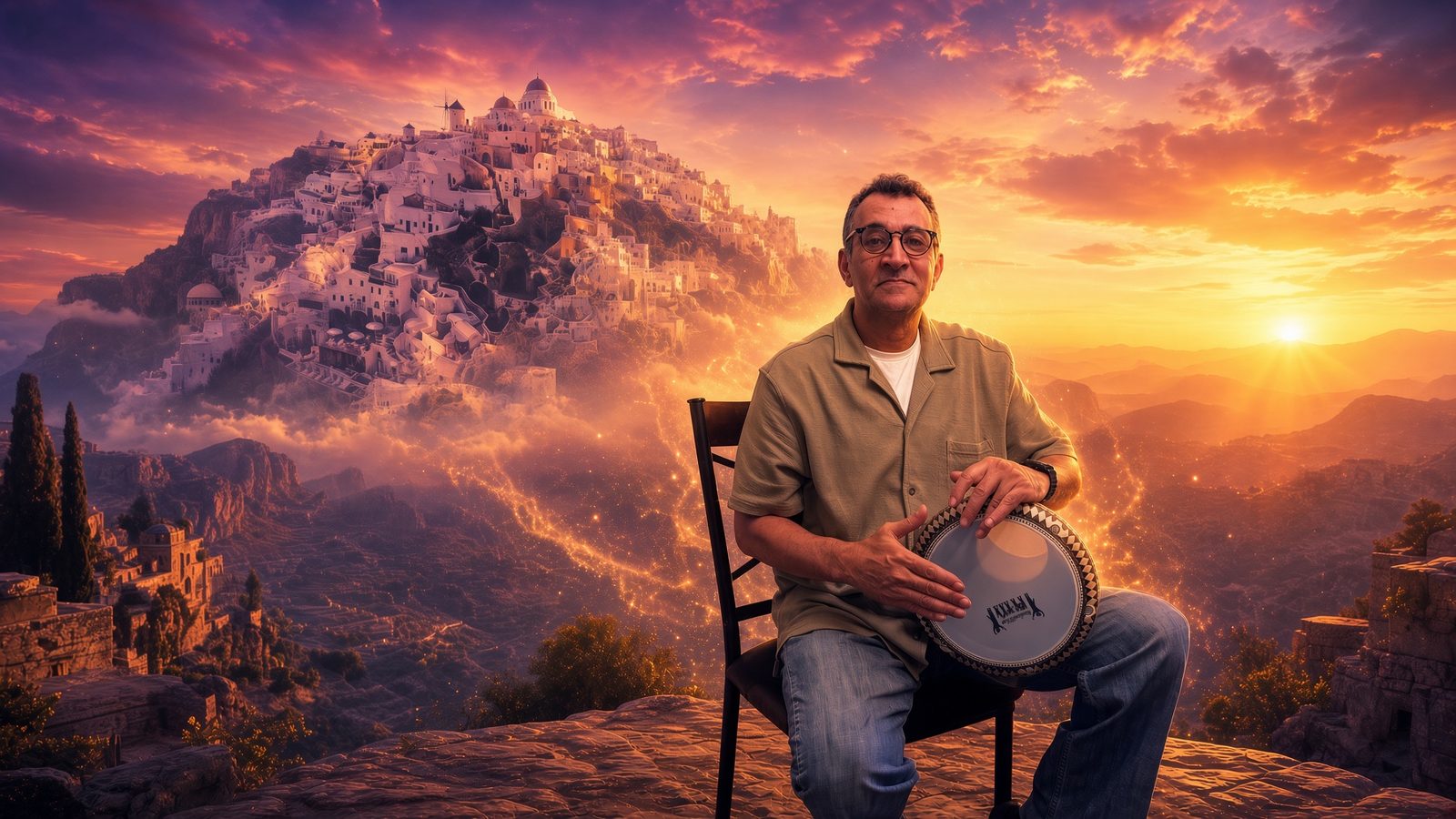
In 2002 I was sitting in an ethnomusicology classroom at the University of Illinois, a Tunisian in the American Midwest, studying the musics of places I had never been. I played darbuka on stage with the Balkanalia Ensemble in those years — a North African drummer inside Balkan rhythms, which is its own kind of education in how far a groove can travel. But the lecture that rearranged my life was not about the Balkans. It was about Greece.
Rebetika. The underground songs of the Greek dispossessed — refugees, dock workers, the urban poor of the early twentieth century. Music made in the margins, scorned by polite society, carried by ear from one cramped room to another. The melodies were simple and devastating; the words were defiance itself. No orchestras, no patrons, no permission. Just the powerless, singing anyway.
I remember the feeling more than the lecture: I know this music. Not the notes — the posture. I had grown up hearing it under a different name.
The same music, three costumes
Raï was born the same way rebetika was. In the port cities of Algeria, it was the music of the streets — sung in the people's Darija, not the schoolroom's Arabic, dismissed as vulgar by the respectable, adored by the blue-collar and the forgotten. Raï singers said what could not be said, and paid for it. It is populist music in the truest sense: it belongs to the people nobody asks for their opinion.
Phonk is the newest child of the same family. Born from Memphis rap tapes traded hand to hand, resurrected decades later by kids on the internet with cracked software and no industry connections whatsoever. Dark, heavy, unpolished on purpose — the sound of making something enormous out of nothing, because nothing was what you were given.
Rebetika, raï, phonk: three continents, three languages, one species. Everywhere on earth, the powerless keep inventing the same kind of music — defiant, direct, melodically simple and emotionally huge, passed mouth to mouth beneath the notice of the official culture. My sociology training later gave me the vocabulary for this; the classroom gave me the pattern; my own life gave me the reason to care.
The choice
So when I finally built my own music, decades later in a Pennsylvania home studio, the choice of ingredients was never aesthetic. It was allegiance. I took raï — my region's music of the unheard — and phonk — this era's music of the unheard — and joined them into Raï w-Phonk. Two musics of the powerless, reinforcing each other. The gasba wails over the 808 because they have always been telling the same story: ما نسلموش — we do not surrender.
Everything I write stands somewhere on that line. The dédicace that opens "Darb El Ghubar" blesses the loyal and the unnamed, the ones who walk heavy — نمشي ثقيل — through lives nobody documents. The refusal engines in my choruses are built for people who have plenty to refuse. I write for the faceless and the nameless because I learned, in a classroom in Illinois, that they have always had the best songs.
I don't imagine one independent artist changes the world. But rebetika didn't imagine it either, and a century later it was being taught, reverently, to a homesick Tunisian in the American Midwest — who carried it home the long way. Music like this is a ticket passed forward: a small contribution that catches an ear, gives an hour of hope, and quietly challenges the status quo. My job is to keep the ticket moving.
— Mourad Youssef Bouajaja, MYB Studio