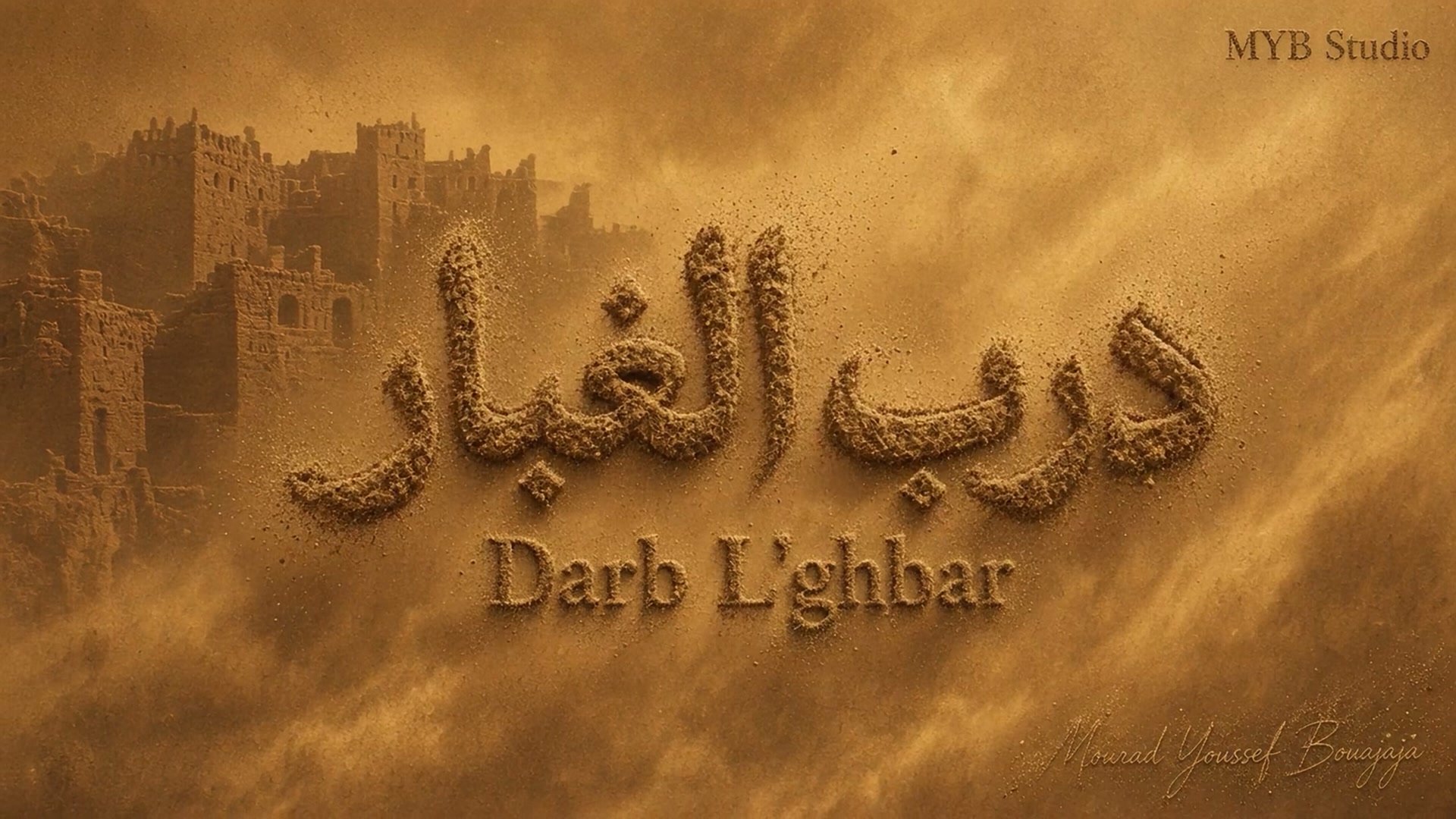
Every story about music and migration is told the same way: the young leave the village, find the city, invent something new, and never look back. The village stays behind as scenery — history, customs, teachings, pride — beautiful, faceless, and abandoned. When I made the film for "Darb El Ghubar", I wanted to walk that story in the other direction.
In my film, it is the elders who leave the village. They do not stay home guarding the traditions and cursing what the children became in the city. They pick up the gasba and the oud — the culture itself, carried in two hands — and they walk the road of dust into the medina, into the neon, into the noise. Poor, faceless, nameless — and carrying everything that matters.
Meeting in the middle of the street
What they find in the city is the lost youth — a generation raised on a different pressure, on phonk, on bass that shakes the car doors, on a style of life the village never taught. And here is the whole film, in one decision: the elders do not reject them. No sermon, no condemnation, no demand to surrender the new music at the village gate. They meet the young exactly halfway — in the middle of the street, between the old sound and the new one — and they accept the phonk and the bass as honestly as they carried the gasba.
And because they accepted first, they earn what no lecture ever earns: the youth walk home with them. Nobody is converted in this film. Nobody wins over anybody. Everyone is completed — the tradition gains a future, and the future remembers its name. That meeting is the genre. That street is where Raï w-Phonk lives.
في درب الغبار نمشي ثقيل وقلبنا ما يعرف الخوف
ما نبدّلوش المسار حتى لو يشعل الغبار بالنار
On the road of dust we walk heavy, and our heart knows no fear — we will not change course, even if the dust ignites into fire. In the film, the fire actually comes: it blazes in the dunes, and the walkers keep walking. The course they refuse to change is not stubbornness. It is the road itself — the one that runs both directions, village to city and back.
Ghorba, resolved
In the broadest sense, this film is about الغربة — ghorba, the exile every emigrant carries and no translation quite holds. I have learned that ghorba is not cured by going back; the village of your childhood exists only in memory now. It is cured the way the film shows: by carrying the village with you into whatever city you landed in, and refusing to let either half of yourself deny the other. I live in Pennsylvania. I was born in Sfax. I put malouf and gasba over 808s. The message under every frame is the simplest promise I know how to make: I will never forget my origins.
There is a shot near the end where I stand in the middle of that neon street myself — my own face, my own glasses, hand on my heart, the old sound glowing on one side of the road and the new one on the other. I put myself there because the film's promise is mine personally, not a costume. The dédicace that opens the song — the old raï tradition of blessing your people by name — is the same gesture: you name where you come from before you sing a single verse. Then you walk.
Watch it on the videos page — it premieres there, on the one place on the internet where the music answers to no one. And if you carry a ghorba of your own, whatever your village was: the road runs both ways. That is the whole teaching.
— Mourad Youssef Bouajaja, MYB Studio